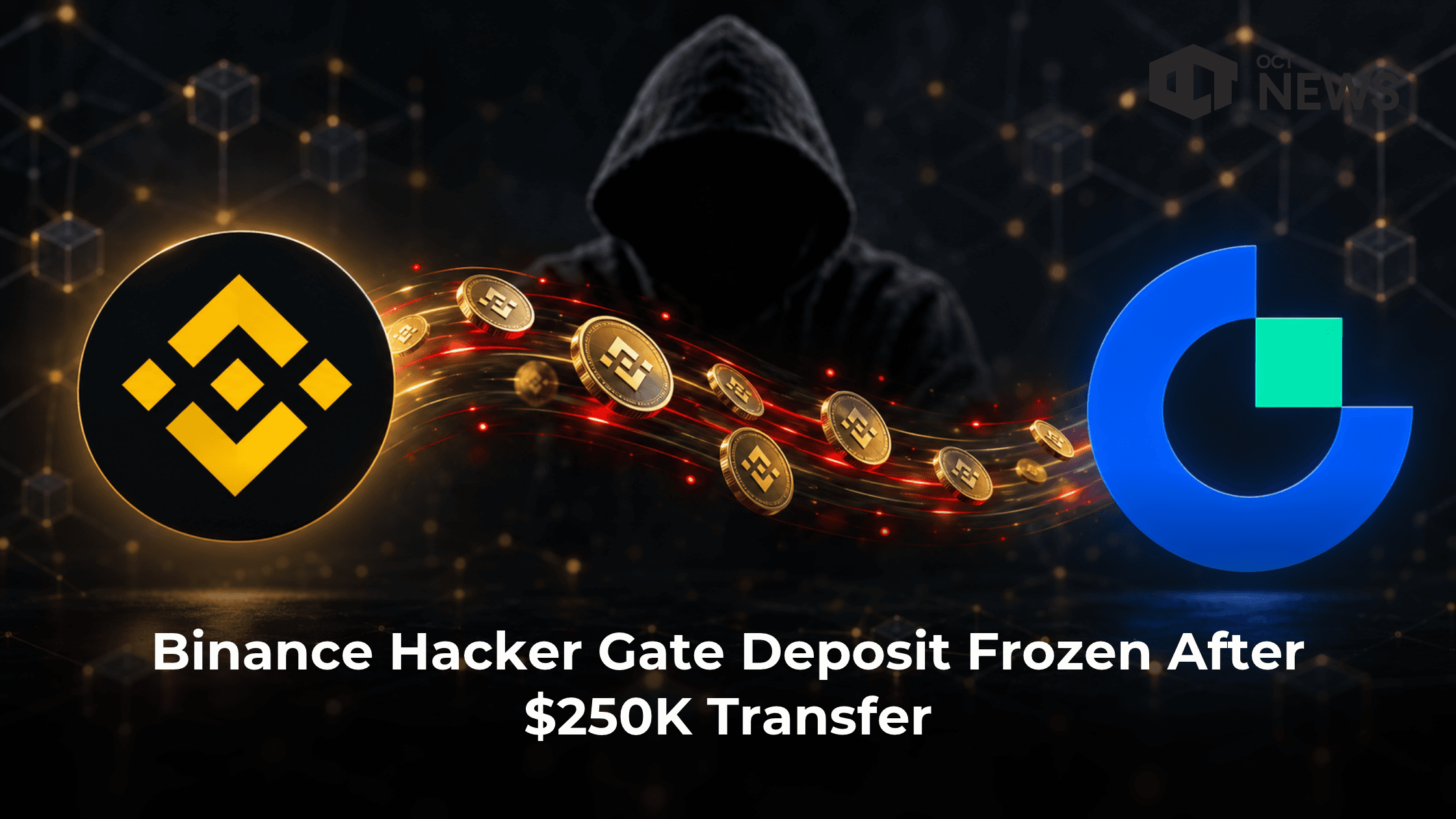
Binance hacker Gate deposits total $250,000 in USDD, according to Lookonchain. Gate says it froze two related accounts.

Author: Kritika Gupta
2nd November 2026- A wallet tied to the Binance hacker deposited about $250,000 into Gate early on Sunday. Within the hour, the exchange froze two related accounts and pledged to cooperate with investigators.
High Signal Summary For A Quick Glance
High attention and emotional sentiment detected.
On-chain tracker Lookonchain flagged the transfers first. According to its alert, the funds moved as USDD over roughly 12 hours, ending around 02:40 UTC on 2 November 2026. Gate then responded publicly about an hour later.
The money came from a single Tron address, TTraqh8FsoxuzguK1DocJW8AFpjsLW7Ybr. According to Lookonchain, it sent seven separate USDD transfers that add up to $250,000.
The amounts were $25,000, four transfers of $40,000, one of $35,000, and one of $30,000. Most landed in Gate deposit addresses, based on the Arkham screenshot shared with the alert.
Arkham Intelligence links that address to the Binance hacker entity. Before the transfers, the wallet received TRX from an address labeled “Binance Hacker” and interacted with SUN.io. As a result, analysts treated the Binance hacker Gate deposit as a likely off-ramp attempt.
Gate moved quickly once the alert went public. In a statement posted at 03:33 UTC, the exchange said it had identified and frozen the two related accounts.
“The relevant information has entered our due diligence process,” Gate wrote. The company added that it would “fully cooperate with law enforcement and ongoing investigation.”
So the response landed within roughly an hour of the public warning. For context, that speed suggests Gate’s compliance team acted on the on-chain flag rather than an internal trigger.
The deposit traces back to a far larger event. On 29 October 2026, attackers drained an estimated $6.3 to $6.4 billion from Binance hot wallets in about 20 minutes.
The theft spanned nine to eleven chains, including Ethereum, Bitcoin and Tron. According to reports, the entry point was a compromised DevOps engineer’s laptop that reached signing infrastructure. Notably, no private-key leak was claimed.
The FBI, Chainalysis, Elliptic and TRM Labs attribute the heist to North Korea’s TraderTraitor group. By most counts, it stands as the largest crypto theft on record.
In the aftermath, issuers and partners froze roughly $2.7 to $3 billion in stablecoins. Meanwhile, Binance covered the losses from company funds and its SAFU reserve, then restored operations.
The attribution rests on standard on-chain forensics. Analysts cluster addresses by shared funding patterns and known entity labels from tools like Arkham and Chainalysis.
In this case, the Tron wallet received TRX directly from a flagged “Binance Hacker” address. It also touched SUN.io, a Tron-based platform, before routing the USDD to Gate. Together, those links placed the wallet inside the hacker’s cluster.
Still, labels are probabilistic, not proof. So the attribution could reflect a related or mislabeled cluster rather than the thief’s own hands. Investigators will likely confirm the chain of custody over time.
Key milestones related to this development
Attackers reportedly drain approximately $6.3–$6.4 billion from Binance wallets across multiple chains.
On-chain analysts track transfers and conversions of suspected stolen funds.
Lookonchain reports seven USDD deposits totaling approximately $250,000 into Gate deposit addresses over 12 hours.
Gate says it identified and froze two related accounts and will cooperate with law enforcement and the ongoing investigation.
Further updates may clarify the deposits and any recovery process. Gate has not disclosed whether authorities will recover or return the funds.
On its own, $250,000 is a rounding error against a multibillion-dollar haul. Still, the move drew outsized attention from on-chain watchers.
Several analysts framed it as a possible test deposit. In other words, the sender may have been checking how fast an exchange would react. Others suggested it could be a decoy or an early laundering probe.
For now, the intent remains unconfirmed, so every reading stays speculative. What is clear is the trade-off the sender faced. A centralized exchange offers a route to fiat, yet it also exposes funds to KYC checks, monitoring and freezes.
That tension explains the outcome. Gate can freeze a credited account and cooperate with investigators. However, it cannot reverse the underlying blockchain transfer once the network confirms it.
Coverage of the alert spread fast across TechFlow, TokenPost, Odaily, Blockchain.News and Cointelegraph. Yet the reports do not fully agree.
Some items, notably from Blockchain.News, tie the Tron address to a 2019 Binance breach instead of the October heist. The dominant, better-sourced narrative links current tracking to the 29 October 2026 incident. Readers should treat the 2019 framing with caution.
Specific transaction hashes for the seven USDD transfers were not available in public results. Therefore the clearest evidence remains the Arkham transfer list in the Lookonchain post.
On X, the dominant take treated the freeze as a quiet win. Many users argued that monitored exchange exits work, and that trackers like Lookonchain outpace compliance teams.
Others were less impressed. Some questioned Gate’s know-your-customer checks, asking how hacker-linked funds reached a deposit address at all. A few called the $250,000 “compliance theater” against a $6 billion backdrop.
Meanwhile, professional analysts stressed the tracking value over the dollar figure. For them, the episode shows how fast public on-chain intelligence now travels.
Expect more of these small flags in the coming days. On-chain analysts continue to track conversions, bridges and exchange deposits linked to the October heist.
The Binance hacker Gate deposit shows the pattern clearly. Monitored exit points can work, and public trackers often move faster than compliance desks. Watch whether additional funds surface at Gate or other venues, and whether Binance or investigators comment directly on the frozen accounts.
Our Crypto Talk is committed to unbiased, transparent, and true reporting to the best of our knowledge. This news article aims to provide accurate information in a timely manner. However, we advise the readers to verify facts independently and consult a professional before making any decisions based on the content since our sources could be wrong too. Check our Terms and conditions for more info.