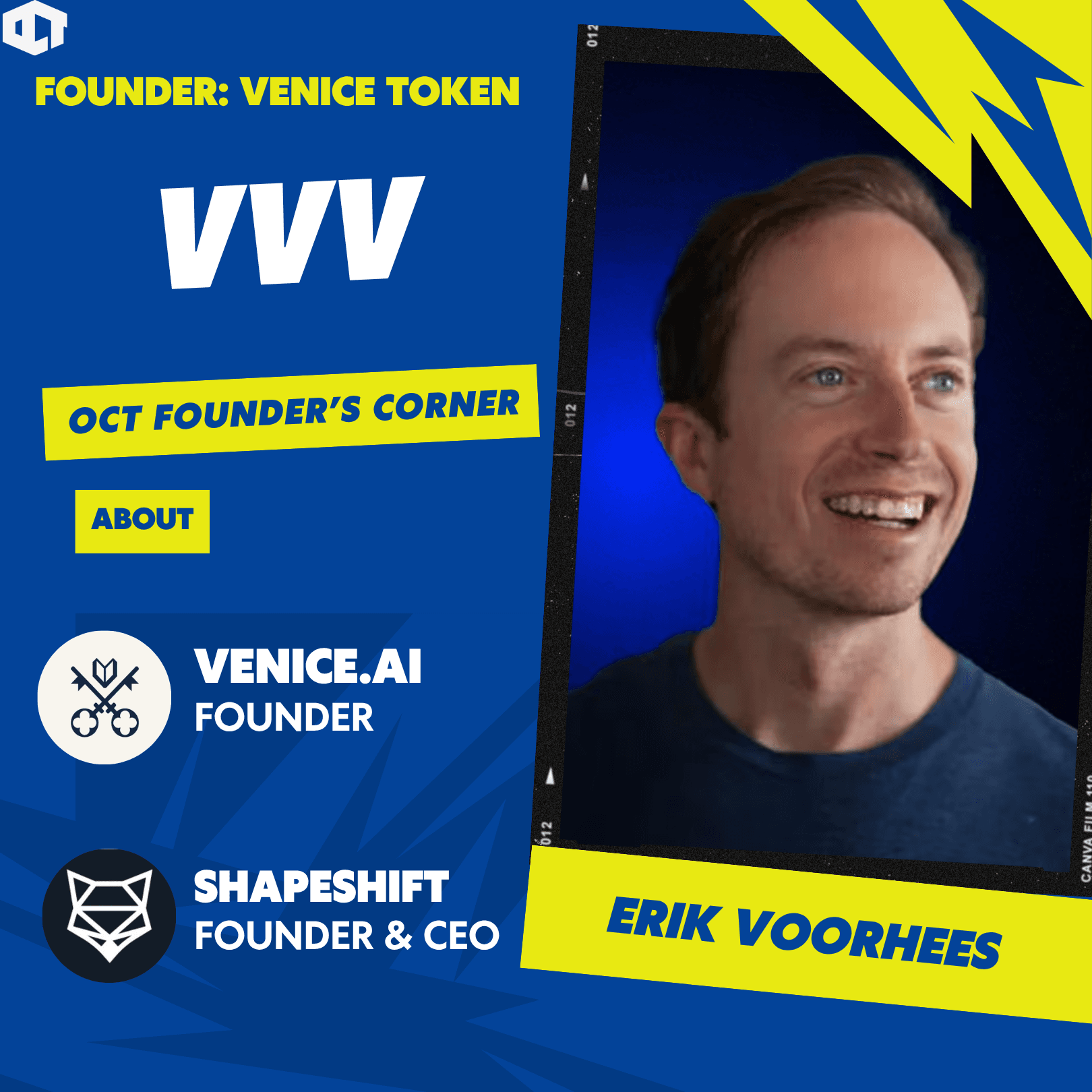
Who Is Erik Voorhees? Venice Token Founder and Crypto-AI Pioneer Explained
Erik Voorhees is the founder of Venice, a privacy-focused AI platform behind the Venice Token VVV. Learn about his background, Venice, and VVV.


Author: Akshay
Erik Voorhees is the founder and CEO of Venice, a privacy-focused AI platform that combines generative artificial intelligence with decentralized infrastructure. Venice provides access to AI models for text, image, video, code, and other applications while emphasizing privacy and permissionless access.
Voorhees is also the founder of ShapeShift and has been involved in the cryptocurrency industry since the early years of Bitcoin. Through Venice and the Venice Token (VVV), he has expanded his focus from decentralized finance and digital assets into the emerging intersection of artificial intelligence and crypto.
Early Background and Career
Erik Voorhees became involved in Bitcoin and cryptocurrency during the industry’s early development. He worked on several Bitcoin-related ventures, including SatoshiDICE, before founding ShapeShift in 2014.
ShapeShift was created as a cryptocurrency exchange focused on allowing users to exchange digital assets without traditional account-based processes. Voorhees served as its founder and CEO and helped establish the company as one of the better-known early crypto businesses.
After spending years working in cryptocurrency and decentralized finance, Voorhees began exploring decentralized artificial intelligence. This eventually led to the creation of Venice in 2024, bringing together his interests in privacy, open technologies, cryptocurrency, and permissionless systems.
How Erik Voorhees Created Venice
Erik Voorhees founded Venice in 2024 after becoming increasingly interested in the combination of artificial intelligence and decentralized technology. The project was designed as a privacy-focused alternative to conventional AI platforms, with an emphasis on keeping user interactions private and providing access to open-source AI models.
Venice launched as a generative AI platform offering capabilities such as conversational AI, document analysis, image generation, and other AI tools. Its infrastructure uses decentralized compute resources and a privacy-oriented architecture in which user content is encrypted and designed not to be stored on Venice’s servers.
The Venice Token (VVV) was subsequently introduced on Base in January 2025. The token was designed to connect the Venice AI platform with a programmable AI economy and provide utility around AI inference capacity.
How Venice and the Venice Token Work
Venice is a privacy-first AI platform that provides access to different AI models for tasks including text generation, image creation, video, coding, and document analysis. Its architecture is designed around privacy, with user content encrypted locally and inference requests routed through infrastructure intended to avoid retaining users’ conversations.
The VVV token is the native asset of the Venice ecosystem and operates on Base. Users can stake VVV to participate in the Venice economy and receive staking rewards. Venice has also introduced DIEM, a tokenized compute unit that can be minted from staked VVV and represents $1 per day of Venice API credit. This allows AI inference capacity to be represented, transferred, and used within the ecosystem.
VVV had an initial supply of 100 million tokens, with allocations directed toward Venice users and the AI community, Venice development, ecosystem incentives, and liquidity. The token’s utility has evolved around staking, AI inference capacity, and participation in the Venice ecosystem.
Erik Voorhees’ Role at Venice
As founder and CEO, Erik Voorhees leads Venice’s overall strategy, product direction, and development. His role combines his previous experience in cryptocurrency with the company’s focus on artificial intelligence and decentralized infrastructure.
Voorhees has positioned Venice around the idea that powerful AI systems should provide users with privacy and greater control over their interactions with machine intelligence. The platform’s development has therefore focused on private AI access, open-source models, decentralized infrastructure, and crypto-based mechanisms for AI services.
His previous experience building ShapeShift has also influenced Venice’s emphasis on permissionless access and reducing dependence on centralized intermediaries.
Why Erik Voorhees Matters in Crypto
Erik Voorhees is a longstanding figure in the cryptocurrency industry, having worked on Bitcoin-related businesses and founded ShapeShift before moving into AI with Venice.
His work with Venice represents a shift from applying crypto primarily to financial services toward using blockchain and decentralized infrastructure in the AI sector. Through VVV, Venice connects token-based economics with AI inference and computing capacity.
This places Voorhees among entrepreneurs working at the intersection of cryptocurrency, decentralized infrastructure, privacy, and artificial intelligence.
Frequently Asked Questions
Who is Erik Voorhees?
What is Erik Voorhees known for?
What is Venice?
What is the Venice Token?
How does VVV work?
In this article
Early Background and CareerHow Erik Voorhees Created VeniceHow Venice and the Venice Token WorkErik Voorhees’ Role at VeniceWhy Erik Voorhees Matters in Crypto