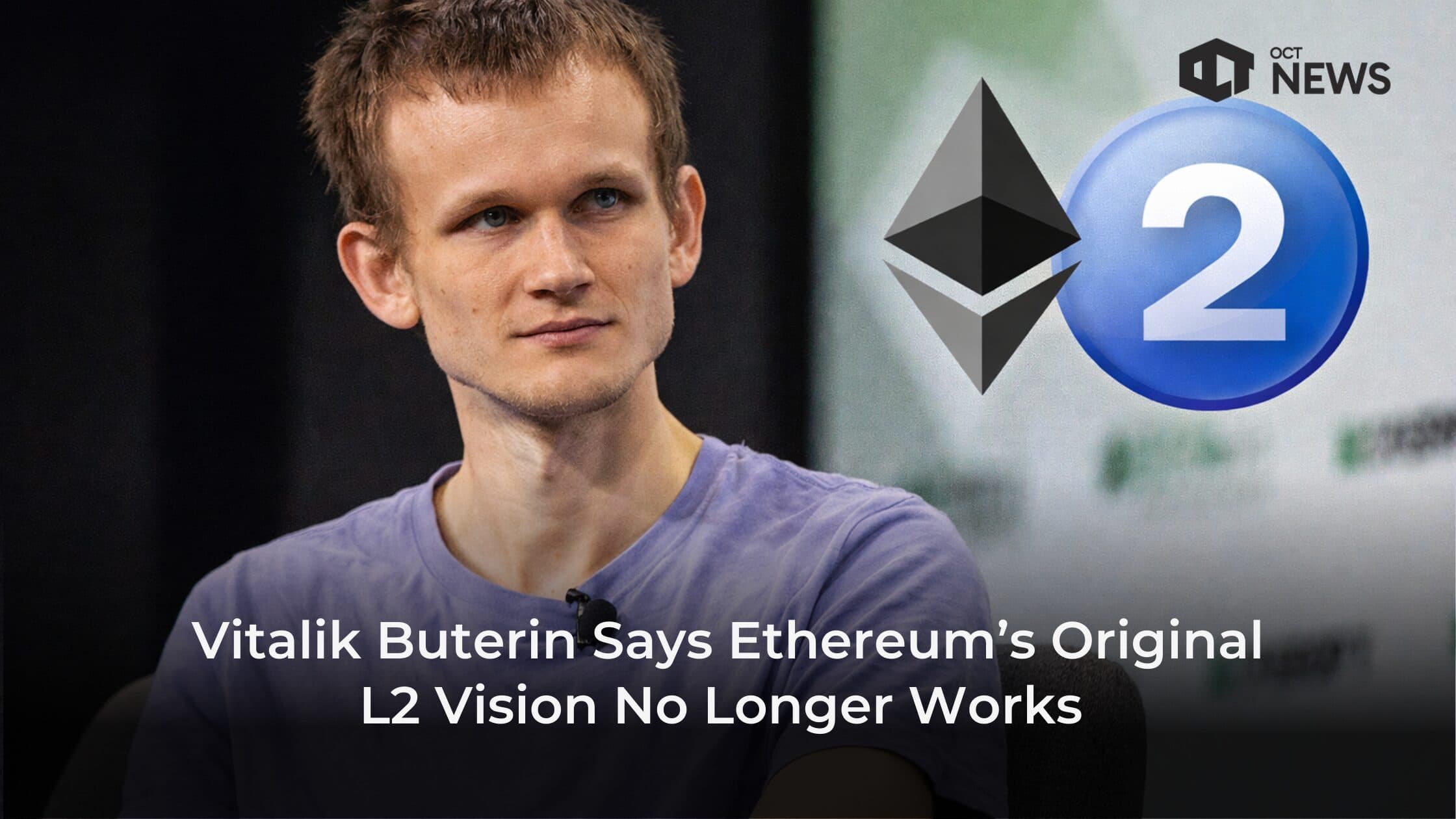
Vitalik Buterin says Ethereum’s original L2 vision no longer works and urges L2s to move beyond simple scaling as the mainnet improves.

Author: Arushi Garg
4 February, 2026: Ethereum co-founder Vitalik Buterin has reignited debate by saying Ethereum’s old Layer 2 scaling model no longer fits today’s network. With lower gas fees and better performance on the mainnet, he believes L2s must evolve beyond simple scaling and focus on unique features like privacy or ultra-fast execution. His comments could reshape Ethereum’s roadmap and push L2 projects to innovate or risk losing relevance.
High Signal Summary For A Quick Glance
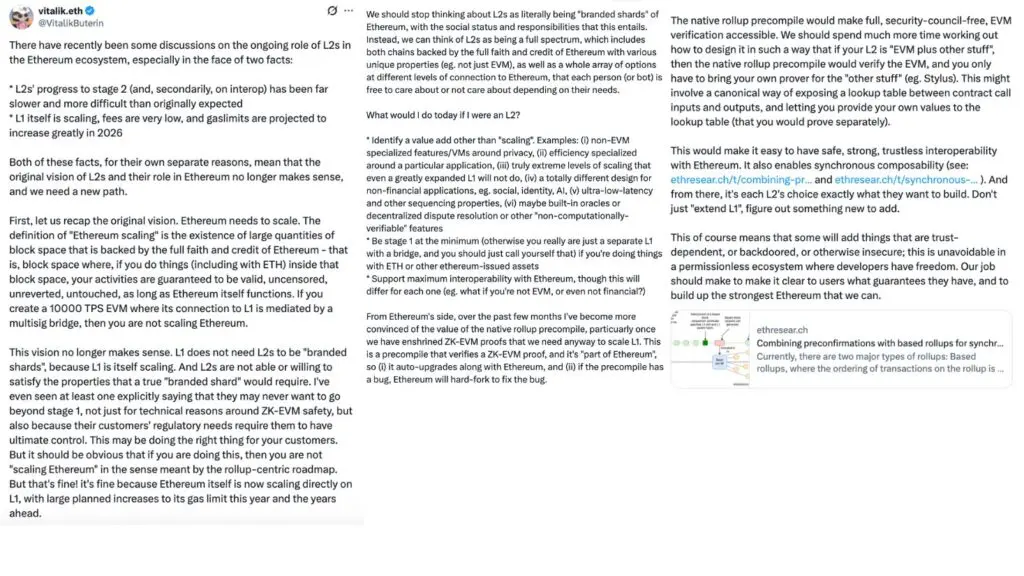
Vitalik Buterin says Ethereum’s old idea for Layer 2 networks no longer fits today’s reality. This comes as Ethereum’s main network (Layer 1) has improved faster than expected, with lower gas fees and plans to raise gas limits in 2026. Because Layer 1 can now handle more activity on its own, Vitalik Buterin believes L2s shouldn’t exist just to reduce congestion. Instead, they should focus on adding unique features, like better privacy, faster transactions, or custom virtual machines.
This isn’t the first time Vitalik Buterin has changed Ethereum’s direction. In 2020, he pushed a “rollup-centric” plan that made L2s the main scaling solution, moving away from sharding. That shift helped drive a strong ETH rally and boosted L2 projects. This time, reactions are mixed. While the long-term vision is still evolving, some L2 tokens like OP and ARB have seen short-term drops as the community debates what role L2s should play going forward.
Key milestones in ARK Invest’s Coinbase and crypto-stock accumulation strategy
ARK Invest purchases roughly $246M worth of Coinbase shares on COIN’s Nasdaq debut, establishing a major position in crypto infrastructure.
During the 2022 downturn, ARK aggressively accumulates Coinbase, treating depressed prices as a long-term entry for digital-asset growth exposure.
ARK purchases about $16.5M in Coinbase shares as Bitcoin slides, reaffirming its bullish stance on crypto exchanges amid volatility.
ARK deploys roughly $56.4M across multiple crypto-related equities including Coinbase, Bitmine, and Circle, positioning into a sector pullback.
ARK adds around $21.8M in crypto exposure across names such as Coinbase, Circle, and Bullish as Bitcoin dips below $90,000.
ARK spends more than $72M on Coinbase, Robinhood, Circle, and Bitmine as Bitcoin drops below $75,000, signaling strong institutional conviction.
Vitalik Buterin’s critique of Layer 2 networks arises from Ethereum’s Layer 1 achieving unexpectedly low gas fees and plans for a 100x gas limit increase in 2026, rendering L2s less critical for basic scaling as the mainnet handles over 1 million TPS-equivalent throughput. Additionally, the slow progress toward full decentralization (Stage 2), with only a few L2s reaching Stage 1, has led to concerns over centralization risks and the original “branded shards” model becoming obsolete.
This reevaluation pushes L2s to evolve beyond scaling, focusing on unique differentiators such as specialized execution environments, privacy protocols, or ultra-low latency for applications like gaming or DeFi. For instance, integrating ZK-EVM precompiles or supporting non-financial use cases could revitalize L2s, preventing ecosystem fragmentation while enhancing Ethereum’s overall modularity and competitiveness against monolithic chains like Solana.
Our Crypto Talk is committed to unbiased, transparent, and true reporting to the best of our knowledge. This news article aims to provide accurate information in a timely manner. However, we advise the readers to verify facts independently and consult a professional before making any decisions based on the content since our sources could be wrong too. Check our Terms and conditions for more info.