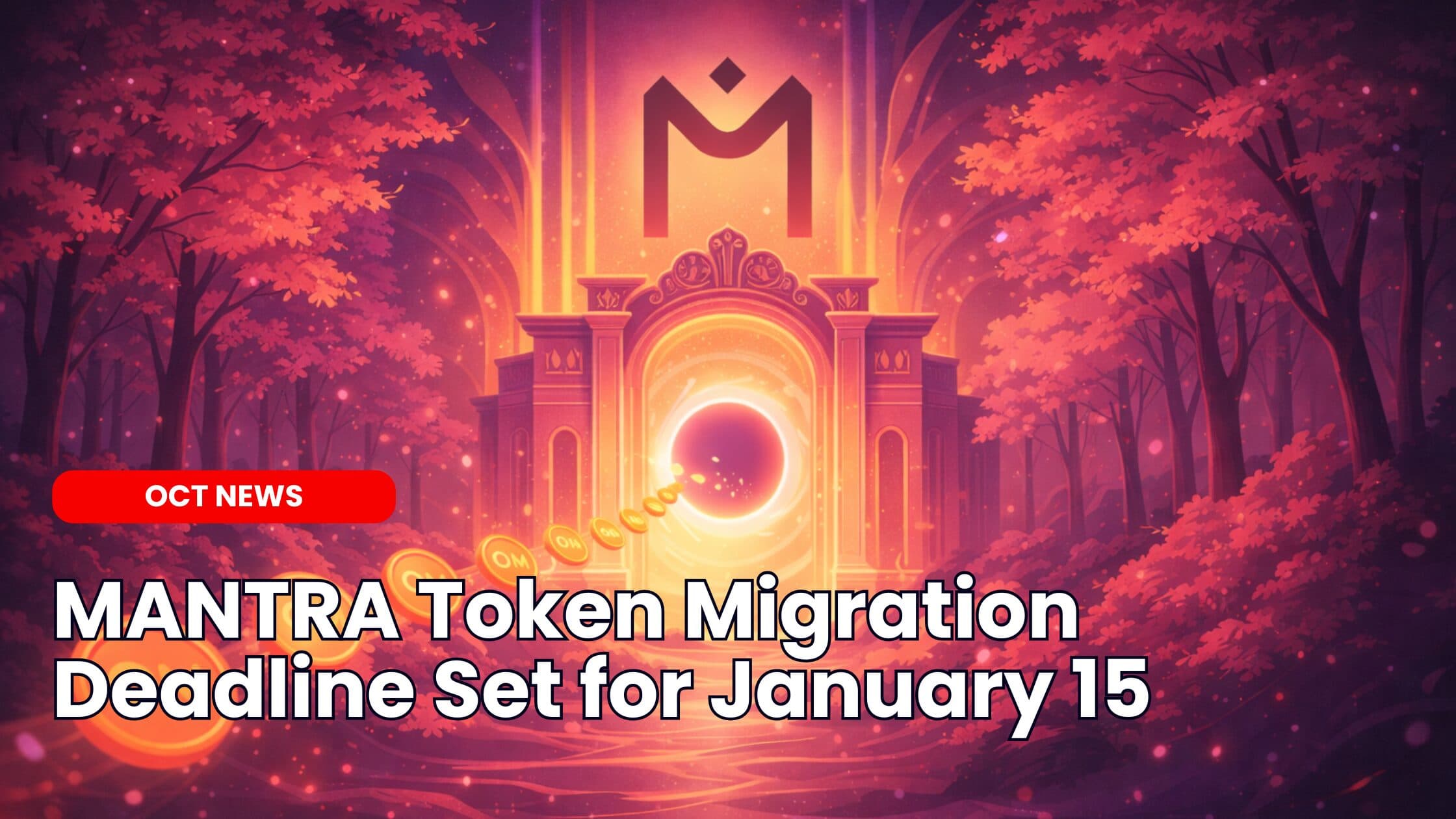
MANTRA announces restructuring and a final OM token migration deadline on January 15 as it refocuses on real world asset tokenization.

Author: Akshay
January 15, 2026. MANTRA Chain moved its token migration to the forefront of its 2026 strategy, confirming January 15 as the final deadline to migrate legacy ERC20 OM tokens to its native network while implementing company wide staff reductions and cost controls. The coordinated actions mark a strategic reset aimed at consolidating liquidity, improving capital efficiency, and sharpening the project’s focus on regulated real world asset tokenization.
High Signal Summary For A Quick Glance

Rahul
@Rahul_2503

@jp_mullin888 Let's build this again bosh 🤝🤝
Today, I’m sharing one of the most difficult decisions we’ve had to make at MANTRA. After the most challenging year MANTRA has faced for a multitude of reasons, I’ve decided to restructure the company. This includes reducing our team size and parting ways with a number of
09:21 AM·Jan 14, 2026
MANTRA Chain’s restructuring follows a turbulent period that began with its pivot from MANTRA DAO to an RWA focused Layer 1, culminating in the launch of its Cosmos SDK based mainnet in October 2024. Rapid expansion, revised tokenomics, and a shift away from ERC20 standards helped drive strong momentum into early 2025, when OM peaked near $8.99 amid a broader market rally.
That momentum collapsed in April 2025 after a sudden 90% price crash linked to forced exchange liquidations during low liquidity conditions. The prolonged bear market, rising competition in RWAs, and elevated operating costs intensified pressure through 2025, making cost cuts and a focus on capital efficiency unavoidable as the project approached its January 2026 token migration deadline.
Sharp token crashes followed by restructurings have occurred repeatedly in crypto. The collapse of Terra in May 2022 saw LUNA lose nearly all its value after UST depegged, forcing a network fork and wiping out billions. Later that year, the failure of FTX triggered mass layoffs, bankruptcy proceedings, and a prolonged market selloff as confidence across the sector eroded.
Beyond outright failures, several major firms survived downturns through cost cutting and refocusing. Coinbase and Binance both reduced headcount during the 2022 to 2023 bear market to improve efficiency. MANTRA’s restructuring aligns with this broader industry pattern, where projects respond to severe drawdowns by streamlining operations in an effort to stabilize and rebuild.
Timeline: MANTRA Token Migration and Network Restructuring
MANTRA launches as MANTRA DAO, a DeFi-focused protocol built on Ethereum, centered on staking, lending, and governance.
The project pivots toward RWA tokenization with the launch of MANTRA Chain using the Cosmos SDK, doubling OM supply to 1.78B.
The OM token reaches an all-time high near $8.99 during the broader market rally, driven by renewed narrative interest.
OM experiences a sharp 90% drawdown, widely attributed to forced liquidations across exchanges during low liquidity conditions.
Proposal 17, titled “OM Homecoming,” announces the ERC20 OM deprecation and urges holders to migrate to native MANTRA Chain.
Roughly 625M OM (about 70%) is migrated by mid-December, supported by multiple exchanges, with delays noted around OKX coordination.
A total of 166M OM is successfully migrated from OKX across nine tranches, resolving one of the largest remaining migration blocks.
The CEO announces internal restructuring to improve efficiency and confirms 93% of OM supply has migrated ahead of the deadline.
The ERC20 OM migration portal closes permanently. Unmigrated tokens are forfeited and reallocated to the MANTRA Chain Association.
MANTRA Chain executes a coin upgrade featuring a ticker change from OM to MANTRA and a 1:4 undiluted redenomination.
The collapse of Terra in May 2022 remains one of the clearest examples of a token crash cascading into systemic damage. LUNA fell more than 99% within days as UST lost its dollar peg, erasing over $50 billion in market value and dragging Bitcoin below $30,000. Crypto Twitter sentiment shifted rapidly from confusion to panic, with accusations of manipulation and widespread rug pull narratives. The fallout deepened the 2022 bear market and triggered global regulatory scrutiny of stablecoins.
A similar dynamic played out during the November 2022 collapse of FTX. Its FTT token plunged over 90% in hours, while Bitcoin fell to $15,000 and the broader market lost more than $200 billion. Social sentiment flipped sharply negative as revelations of fund misuse emerged, amplifying fear and accelerating contagion. The aftermath included bankruptcies, mass layoffs, and a prolonged crypto winter, reinforcing a recurring pattern where severe crashes force restructurings, tighter cost control, and a renewed focus on operational resilience.
Comparison against MANTRA’s past crisis responses and restructuring precedents across crypto
MANTRA Chain now enters a critical execution phase, with attention centered on confirmation of final ERC20 OM migration figures following the January 15, 2026 cutoff and any impact on circulating supply or liquidity. Beyond the immediate deadline, focus will shift to the March 2, 2026 chain level upgrade, including the OM to MANTRA ticker change and 1 to 4 redenomination, which will test technical readiness, exchange support, and user confidence. Progress on RWA initiatives, regulatory alignment in key regions, and communication from CEO John Patrick Mullin will be key signals, while execution delays, low post migration activity, or renewed market volatility could undermine recovery expectations through 2026.
Our Crypto Talk is committed to unbiased, transparent, and true reporting to the best of our knowledge. This news article aims to provide accurate information in a timely manner. However, we advise the readers to verify facts independently and consult a professional before making any decisions based on the content since our sources could be wrong too. Check our Terms and conditions for more info.


Ledger Probes User Fund Losses Tied to Reseller CryptoBilis
Why Provenance Blockchain (HASH) Is Up 39.6% Today?
Halborn Clears XMAQUINA RCM Audit With Zero Critical Bugs
Fidelity Scoops $354M Bitcoin, ETH & SOL in 20 Days
Ledger Probes User Fund Losses Tied to Reseller CryptoBilis
Why Provenance Blockchain (HASH) Is Up 39.6% Today?
Halborn Clears XMAQUINA RCM Audit With Zero Critical Bugs
Fidelity Scoops $354M Bitcoin, ETH & SOL in 20 Days