Aster DEX faces renewed scrutiny over its trading volumes as analysts question user activity despite strong public backing from CZ.

Author: Arushi Garg
Steady attention without excessive speculation.
Aster DEX, the high-volume perpetual futures platform linked to Changpeng Zhao, is facing fresh scrutiny as its final Stage 6 airdrop round nears completion. Analysts are questioning whether its reported $20B to $29B weekly trading volumes reflect real user activity or wash trading aimed at boosting airdrop rewards.
The debate comes despite CZ’s $2 million ASTER purchase in November 2025 and his public backing of the exchange as a strong Hyperliquid competitor. With the airdrop snapshot approaching, the project’s credibility is once again being tested.
High Signal Summary For A Quick Glance

Ali
@AleyProbably

@stacy_muur @Aster_DEX This feels fake, couldn't be that low. Even I have referrals on Aster which continue to make me some money, so this doesn't sound right.
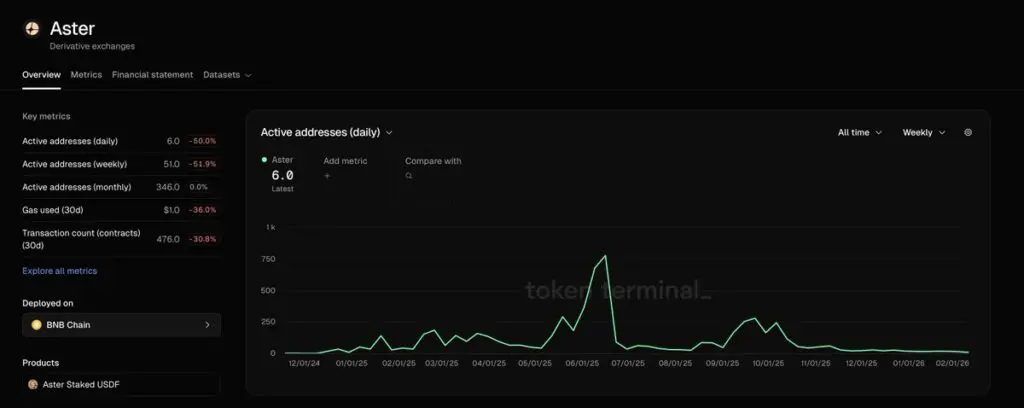
Oh wow Your favorite @Aster_DEX: • 6 daily active addresses • 51 weekly • 346 monthly What went wrong, CZ? https://t.co/AMrSPk0m2F
01:40 PM·Feb 18, 2026
Aster DEX has been reporting massive perpetual futures volumes between $20B and $29B weekly while running its final Stage 6 airdrop campaign launched on February 2, 2026. This spike has triggered fresh scrutiny from community analysts on X, who question whether the activity is organic or driven by wash trading, especially given the project’s links to Changpeng Zhao and YZi Labs.
This is not the first controversy. In October 2025, DeFiLlama delisted Aster’s perp data after volumes crossed $100B, citing suspicious mirroring with Binance and limited order transparency. The move led to a 15 to 20 percent price drop, but the token later rebounded following a $214M buyback and new utility launches, showing resilience despite repeated wash trading concerns.
Fresh scrutiny intensified on February 18 after on-chain analyst Stacy Muur shared Token Terminal data showing Aster’s main yield stablecoin contract with just 6 daily active addresses, 51 weekly, and 346 monthly. These figures appeared inconsistent with the platform’s claimed $2.4B daily and over $17B weekly perpetual futures volume.
Supporters responded by arguing the data focused on a single contract, asUSDF, and did not reflect full platform activity. They cited broader metrics showing 4,673 unique traders in the past 24 hours, along with $1.1B in total value locked and $1.7B in open interest. The debate now centers on whether the reported volume reflects real trading or wash activity ahead of the final Stage 6 airdrop snapshot.
Our Crypto Talk is committed to unbiased, transparent, and true reporting to the best of our knowledge. This news article aims to provide accurate information in a timely manner. However, we advise the readers to verify facts independently and consult a professional before making any decisions based on the content since our sources could be wrong too. Check our Terms and conditions for more info.



Aster