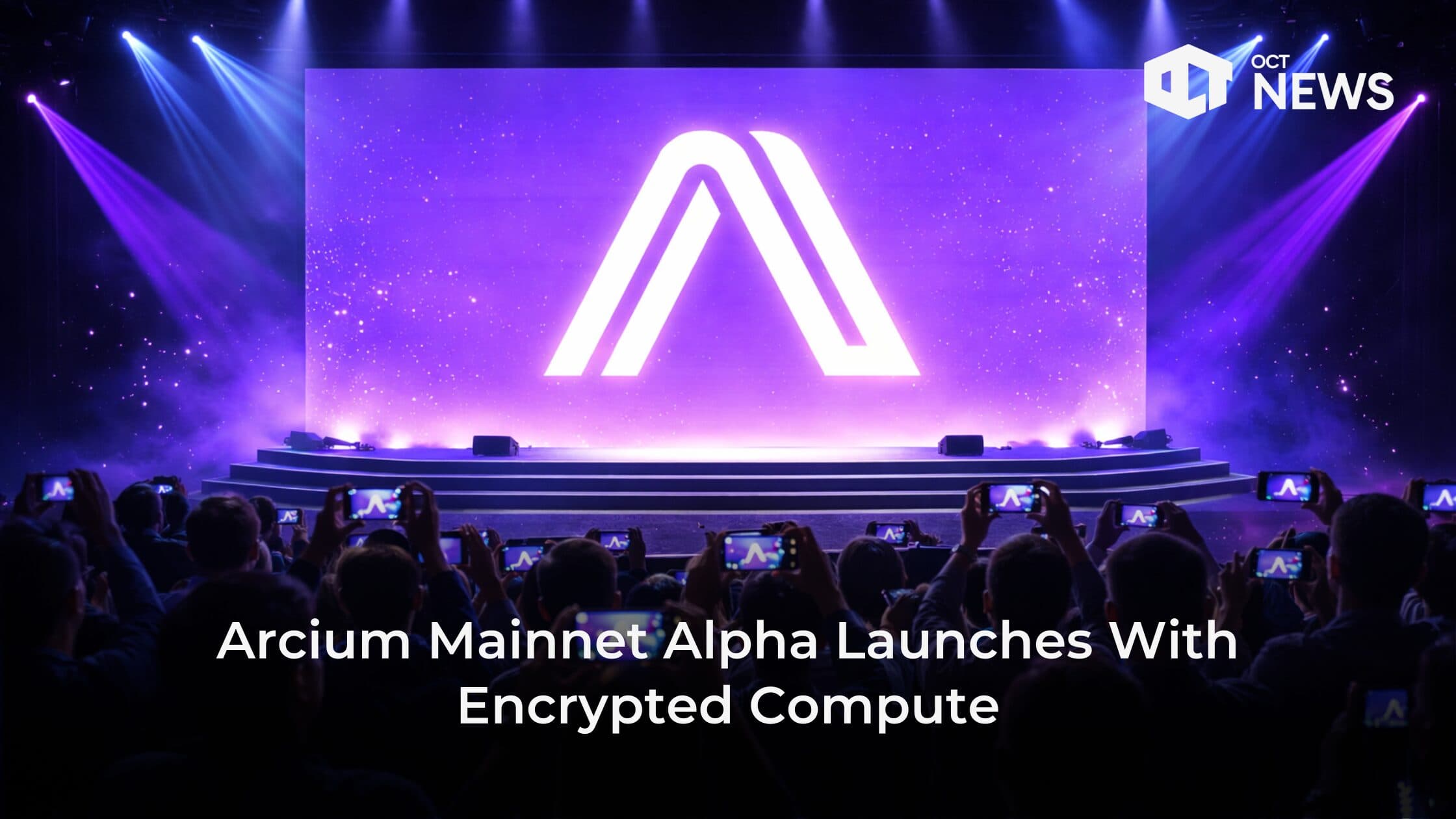
Arcium launches its Mainnet Alpha, bringing encrypted compute to production with a permissioned rollout ahead of full decentralization.

Author: Akshay
Steady attention without excessive speculation.
January 10, 2026. Arcium has launched its Mainnet Alpha, marking the first production deployment of its encrypted supercomputer network. The rollout begins with a permissioned cluster of four node operators, prioritizing performance, security, and user experience before broader decentralization. Alongside the launch, Arcium activated the RTG Portal and Checker, revealing Wave 1 eligibility and enabling early participants to verify rewards and access.
High Signal Summary For A Quick Glance

Solflare - The Solana Wallet
@solflare

@Arcium Congrats team!!
Arcium Mainnet Alpha is Live. https://t.co/cCq8YZlcBn
03:13 PM·Feb 2, 2026
Arcium is a privacy focused compute protocol building an “encrypted supercomputer” on Solana. The Mainnet Alpha launch on February 2, 2026 moves the project from testnet to early production, enabling encrypted execution on mainnet and introducing Umbra as the first live app for private financial use. The initial setup is permissioned to prioritize stability and performance before wider decentralization.
The rollout followed Arcium’s public roadmap. Multi phase testnets across 2025 validated MPC performance, node operations, and encrypted apps, while team updates and RTG tooling prepared builders ahead of launch. As a result, the timing was expected within the community, with discussion framing Mainnet Alpha as a foundational step toward privacy first applications and encrypted capital markets on Solana.
A close historical parallel to Arcium’s rollout is Elusiv, a zero knowledge privacy project built on Solana by the same core team. Elusiv launched on Solana mainnet in March 2023 with private transfers, later expanding to private token swaps in August 2023. It marked one of Solana’s earliest production grade privacy layers and helped validate demand for confidential on chain activity.
Elusiv was well received by builders and privacy advocates, securing $3.5 million in seed funding before launch, but it operated without a native token, limiting direct market impact. Regulatory complexity and scope constraints ultimately led to Elusiv being sunset in early 2024, allowing the team to refocus on Arcium. That transition positioned Arcium as a direct evolution, extending Elusiv’s privacy learnings into a broader encrypted compute and capital markets framework rather than a single purpose privacy app.
Timeline: Arcium Roadmap from Testnets to Mainnet Alpha
Arcium publishes its first roadmap outlining four stages, spanning private and public testnets through to mainnet.
An incentivized private testnet goes live for early builders, enabling experimentation with confidential compute primitives.
Arcium conducts a community funding round on CoinList, expanding community ownership ahead of public testnets.
The “Test, Demo, Iterate” phase launches, focusing on demo applications, feedback loops, and early community voting.
The “Stake, Scale, Decentralize” phase introduces staking mechanics and third-party nodes to harden the network.
The final testnet phase focuses on scaling private compute and validating production readiness ahead of mainnet.
Arcium launches Mainnet Alpha on Solana, enabling initial encrypted execution and debuting the Umbra application.
Umbra is expected to roll out fully on mainnet following security audits, expanding access to private compute use cases.
Arcium targets a full mainnet launch with complete decentralization, alongside the ARX token generation event.
The most direct comparison to Arcium is Elusiv, which launched its zero knowledge privacy layer on Solana in March 2023. Elusiv had no native token, so there was no direct price impact. SOL traded broadly flat around the launch, with later volatility driven by macro events such as the Silicon Valley Bank collapse rather than Elusiv itself. Market reaction remained neutral, with attention focused on technology instead of speculation.
Sentiment on Crypto Twitter was largely positive and framed Elusiv as a meaningful step forward for onchain privacy on Solana. Developers highlighted private transfers as a strategic upgrade that strengthened Solana’s long term narrative. The larger impact came through second order effects. Elusiv processed significant private volume, open sourced its SDK, and helped normalize privacy as core infrastructure. Although the project was sunset in 2024 due to regulatory pressure, its launch directly informed Arcium’s broader encrypted compute vision and positioned privacy as a foundational capability rather than a standalone feature.
Comparison with Arcium’s earlier public testnet phases leading up to Mainnet Alpha
Following the February 2, 2026 Mainnet Alpha launch, Arcium has entered a controlled rollout focused on stability and real usage. The immediate focus is Umbra, which is onboarding users gradually while audits and performance checks continue. Progress on additional Retroactive Token Grant waves and early developer integrations will be key short term signals.
The broader narrative depends on execution. If encrypted workloads scale smoothly and third party builders begin shipping apps on Solana, Arcium can move from alpha testing to core privacy infrastructure. Delays in decentralization, audit issues, or regulatory pressure around privacy tools would slow momentum and shift expectations.
Our Crypto Talk is committed to unbiased, transparent, and true reporting to the best of our knowledge. This news article aims to provide accurate information in a timely manner. However, we advise the readers to verify facts independently and consult a professional before making any decisions based on the content since our sources could be wrong too. Check our Terms and conditions for more info.