Alephium prepares the v4.3.0 full node upgrade for the January 14 mainnet activation, introducing network improvements and upgrade readiness.

Author: Akshay
December 24, 2025. Alephium v4.3.0 Upgrade preparations are underway as the network reminds node operators to update before the scheduled mainnet activation on January 14, 2026, at 10:00 UTC. The release introduces key network enhancements while remaining backward compatible to ensure a smooth transition.
Alephium launched its mainnet in 2021 as a sharded Layer 1 using Proof of Less Work and BlockFlow consensus. Its stateful UTXO model enables efficient smart contracts while preserving the security guarantees of UTXO based systems.
Previous milestones include protocol level sharding, cross shard execution, and privacy upgrades. The v4.3.0 release continues Alephium’s steady cadence of network improvements focused on performance and developer usability.
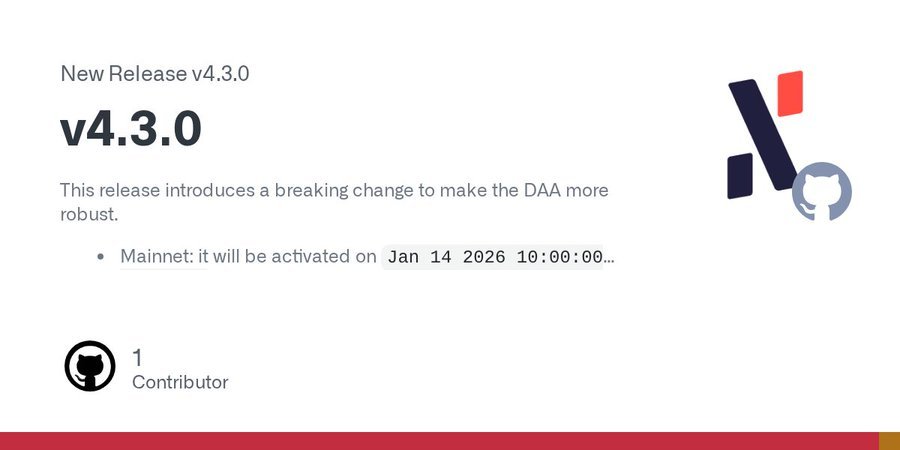
The reminder for Alephium’s Full Node v4.3.0 upgrade, with mainnet activation scheduled for January 14, 2026, has elicited a neutral to slightly positive short-term response in pricing. As a routine maintenance announcement emphasizing preparation without highlighting major new features, it generated limited hype. Current price hovers around $0.11–$0.13 USD across major trackers (CoinMarketCap ~$0.115, CoinGecko similar), with 24 hour changes ranging from -3% to +2%, reflecting broader market sentiment rather than event specific volatility.

Ryukyuu 👩🚀
@AkiraRyukyu

@alephium Thanks for the heads up Alephium, I’ll make sure my node is upgraded before Jan 14
🛰️ Full Node Upgrade Reminder Alephium’s Full Node v4.3.0 upgrade is approaching activation, and nodes should be upgraded in preparation for the upcoming network change. ⏰ Mainnet activation: Jan 14, 2026 at 10:00 UTC 📢 Node operators are advised to upgrade ahead of the
12:44 AM·Dec 24, 2025

100X CryptoGems
@CryptoGems100YT
@alephium Good reminder for node operators! Staying upgraded is key for a stable $ALPH network 💪
🛰️ Full Node Upgrade Reminder Alephium’s Full Node v4.3.0 upgrade is approaching activation, and nodes should be upgraded in preparation for the upcoming network change. ⏰ Mainnet activation: Jan 14, 2026 at 10:00 UTC 📢 Node operators are advised to upgrade ahead of the
12:23 PM·Dec 23, 2025

𝐂𝐫𝐮𝐬𝐡 🥷🏻
@Zayyad_Yazeed
@alephium Important reminder for node operators. Upgrade ahead of Jan 14 to stay fully in sync with the network. Strong foundations matter. #Alephium $ALPH
🛰️ Full Node Upgrade Reminder Alephium’s Full Node v4.3.0 upgrade is approaching activation, and nodes should be upgraded in preparation for the upcoming network change. ⏰ Mainnet activation: Jan 14, 2026 at 10:00 UTC 📢 Node operators are advised to upgrade ahead of the
10:43 AM·Dec 23, 2025
In 2025, Alephium focused on consistent development, highlighted by the Danube hard fork that cut block times to 8 seconds and pushed throughput beyond 20,000 TPS. The upgrade also improved user experience by abstracting shard complexity for smoother dApp interactions.
The network expanded its enterprise focus through custody partnerships, community programs, and a Phase 2 roadmap covering staking and a Core DEX. With continued optimizations and the upcoming v4.3.0 upgrade in January 2026, Alephium is positioning itself as a regulated friendly PoW platform for DeFi and RWAs.
Alephium’s v4.3.0 upgrade shows how backward compatible updates help networks evolve without disruption. It highlights node operator responsibilities, Proof of Work security, and sharding through BlockFlow and sUTXO for scalability. Timely upgrades prevent forks and illustrate the balance between innovation and long term Layer 1 stability.
Our Crypto Talk is committed to unbiased, transparent, and true reporting to the best of our knowledge. This news article aims to provide accurate information in a timely manner. However, we advise the readers to verify facts independently and consult a professional before making any decisions based on the content since our sources could be wrong too. Check our Terms and conditions for more info.