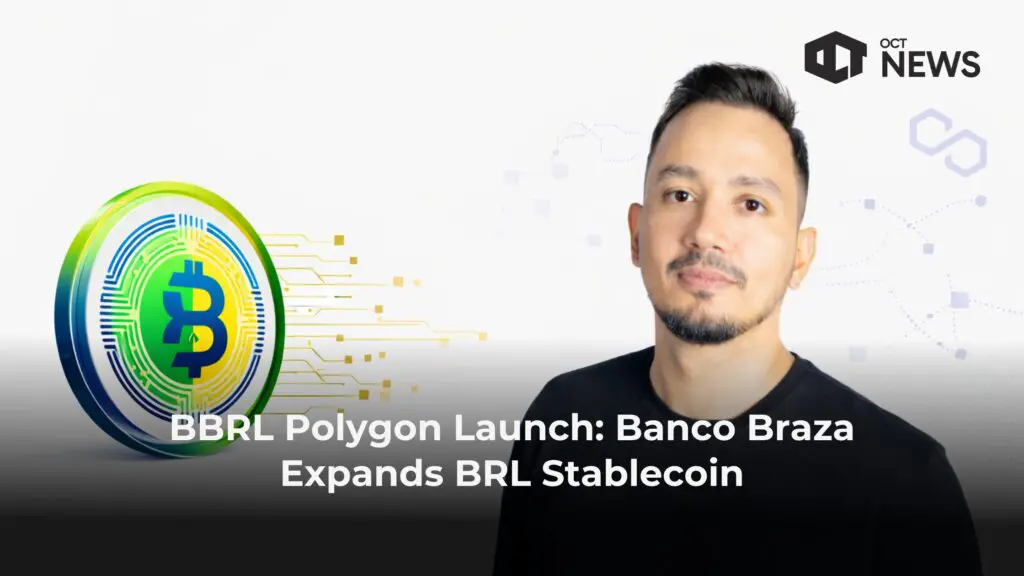
January 16, 2026, Banco Braza announced the BBRL Polygon launch, introducing its fully reserve backed Brazilian Real stablecoin issued directly on Polygon’s mainnet. The token is pegged 1:1 to BRL and backed by cash and cash equivalent reserves held in regulated Brazilian financial institutions. The rollout marks one of the first regulated BRL stablecoin issuances by a major Brazilian bank on a public blockchain network.
High Signal Summary For A Quick Glance
- Banco Braza has launched the Brazilian Real stablecoin $BBRL on Polygon.
- $BBRL expands real-world FX banking exposure into onchain infrastructure.
- The move strengthens Polygon’s positioning as a payments-focused blockchain.
- Represents growing institutional adoption of stablecoins in Latin America.
- Brazilian businesses and users seeking BRL-denominated onchain liquidity.
- Polygon ecosystem participants and DeFi protocols.
- Institutional players exploring regulated stablecoin rails.
- Cross-border payment providers operating in LatAm corridors.
Background and Context Behind the BBRL Polygon Launch
BBRL is a Brazilian Real stablecoin pegged 1:1 to BRL and issued by Braza Crypto, with reserves held at Banco Braza, a regulated institution under Brazil’s Central Bank. The bank is a major foreign exchange provider, and BBRL is fully backed with mint and redemption at parity through the banking system, positioning it as a compliant bridge between traditional finance and blockchain payments.
Before launching on Polygon, BBRL was deployed on the XRP Ledger and later expanded to additional networks as part of a multi chain strategy. Its expansion to Polygon reflects rising demand for low cost on chain payments in Latin America and signals deeper institutional use of public blockchain infrastructure for national currency settlement.
<<-tweet-2026419623206551771->>
Comparable Stablecoin Launches by Brazilian Institutions
Brazilian institutions have previously expanded stablecoins onto Polygon to improve payment efficiency. In 2023, BTG Pactual launched its USD pegged BTG Dol on Polygon, generating positive institutional adoption sentiment and a short term 5 to 7 percent uplift in MATIC alongside higher network activity.
Transfero’s BRZ stablecoin also expanded to Polygon to benefit from lower fees and faster settlement, increasing non-USD stablecoin usage in Latin America. Similarly, the BBRL Polygon launch reflects this broader regional trend rather than an isolated move.
Comparison of BBRL Expansion: XRPL vs. BNB Chain vs. Polygon
Token and Market Reaction Patterns in Comparable Stablecoin Expansions
Brazilian stablecoin launches on Polygon have typically led to modest short term price gains rather than major rallies. After BTG Pactual’s BTG Dol debut, MATIC rose around 5 to 7 percent, supported by positive sentiment around institutional adoption, though momentum later aligned with broader market trends.
Transfero’s BRZ expansion had a gradual impact, lifting stablecoin activity and TVL on Polygon without sharp volatility. Similarly, the BBRL Polygon launch reinforces Polygon’s positioning as a regional payments hub rather than triggering immediate price disruption.
What Readers Should Watch Next for BBRL on Polygon
Attention now shifts to adoption and compliance. Key indicators include on chain transfer volume, liquidity growth on Polygon, and continued reserve attestations under Brazil’s regulatory framework. Integrations with payment platforms or tokenized asset use cases would further validate the expansion.
At the same time, competition from other BRL stablecoins and evolving foreign exchange rules could influence growth. Strong transaction metrics would reinforce the payments narrative, while regulatory friction or muted adoption could slow momentum.