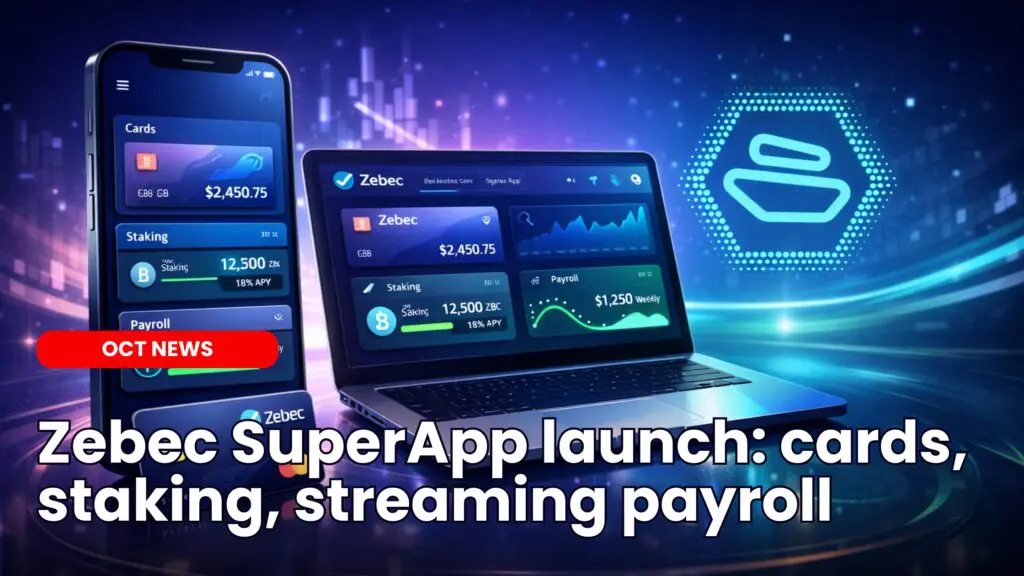
January 10, 2026. The Zebec SuperApp launch was announced by Zebec Network, outlining a unified mobile platform that combines debit cards, $ZBCN staking, and real-time streaming payroll into one on-chain financial experience. The redesign aims to remove friction from everyday finance by eliminating the need to switch between separate apps or dApps. While no exact release date has been confirmed, the product is positioned as “coming soon,” pointing to a likely Q1 2026 launch.
High Signal Summary For A Quick Glance
- Zebec has announced a new SuperApp consolidating cards, staking, and streaming payroll.
- The platform introduces a unified user experience across Zebec’s core financial products.
- The redesign aims to simplify everyday crypto-native payments and income flows.
- The Zebec SuperApp is scheduled to launch soon.
- Zebec card users managing spending and payments.
- Token holders participating in staking through a single interface.
- Employers and employees using streaming payroll solutions.
- New users onboarding into Zebec’s financial ecosystem.
Zebec moves toward a unified PayFi experience
Zebec Network is a blockchain platform focused on real-time payment streaming, with the Zebec SuperApp launch extending its model to consumer-facing tools. Originally built on Solana, the platform now supports more than 18 networks and includes debit cards for everyday spending alongside continuous payroll and stablecoin payouts.
The upcoming Zebec SuperApp brings cards, staking, and streaming payroll into a single interface. Teased throughout 2025 and aligned with the 2026 roadmap, the launch is viewed as an expected milestone that supports Zebec’s shift from a payroll protocol into a broader PayFi platform aimed at mainstream adoption.

A prior SuperApp rollout set the foundation
Zebec Network previously launched an initial version of its SuperApp in late 2025, with the Zebec SuperApp launch unifying payroll streaming, cards, and staking into a single PayFi interface. The beta went live in October, followed by a broader rollout through November and December after weeks of teasers around a unified, multi-chain payments experience.
The outcome was broadly positive. User engagement increased, card volumes scaled, and enterprise payroll usage expanded, although early UX issues required follow up refinements and a brief staking migration pause. Market reaction was bullish but volatile, with ZBCN rising around 15 to 20 percent on launch hype before correcting. Overall, the 2025 rollout is viewed as a successful first step that set the stage for the more refined SuperApp release planned for 2026.
Timeline: Zebec SuperApp Phased Rollout and Platform Reimagining
SuperApp vision introduced
Zebec begins teasing the SuperApp as a unified PayFi platform combining cards, payroll streaming, staking, and financial management.
Legacy app transition signaled
The team signals plans to phase out older products such as WageLink in favor of the upcoming SuperApp, building anticipation for a unified experience.
Initial SuperApp beta launches
Zebec launches the first SuperApp beta, consolidating core features. Adoption expands through Q4 as the rollout completes across web users.
Wallet and payments infrastructure prepared
Key integrations such as Privy and Stripe are announced, enabling embedded wallets and smoother onboarding within the SuperApp.
Countdown and roadmap disclosures
Zebec launches a public countdown and hosts CEO-led Spaces outlining the 2026 roadmap, positioning the SuperApp upgrade as a core initiative.
Staking transition begins
Staking on the legacy site is paused and auto-migrated into the SuperApp module. Updated tokenomics go live with no user action required.
Reimagined Zebec SuperApp unveiled
Zebec officially announces the new SuperApp experience, unifying cards, staking, and streaming payroll. Phased rollout begins with desktop and web.
Core features integrate weekly
Staking becomes fully live inside the SuperApp, alongside the unified dashboard and embedded wallets released through weekly updates.
Mobile app and PayFi expansion
The mobile SuperApp launches following the web rollout, alongside multi-chain payroll enhancements and broader PayFi functionality.
Tiered card rewards activate
Enhanced card perks and cashback unlock based on staked ZBCN balances and SuperApp engagement levels.
Final token unlock completes
The last scheduled token unlock concludes, transitioning ZBCN into a fully deflationary model supported by revenue-driven buybacks.
Prior launches shaped expectations for the SuperApp rollout
Zebec Network has faced similar moments before, especially the initial SuperApp beta in late 2025. That release drove a bullish move in $ZBCN followed by a brief correction, while Crypto Twitter sentiment stayed positive and utility focused. The unified PayFi narrative helped lift active users and payroll volume, reinforcing confidence in the product direction.
A comparable pattern appeared during the January 2026 roadmap update and earlier partnership waves. Prices dipped on uncertainty, then stabilized as details clarified. Second order effects included higher staking participation, deeper integrations, and growing on chain activity. These precedents suggest short term volatility but longer term ecosystem expansion around major Zebec launches.
Comparison with unified streaming payment and PayFi updates from competing projects
Execution and regulatory risks to watch
Zebec Network faces execution risk as the SuperApp rolls out in phases from web to mobile through Q1 2026. Prior betas required UX fixes and brief staking pauses, which could resurface and slow weekly updates or integrations like embedded wallets. Scaling real time payroll across 19 plus chains also raises infrastructure risk as volume grows beyond the current $400M annual run rate.
Regulatory and market risks remain material. Stablecoin payroll, cross border remittances, and debit cards face evolving oversight despite Zebec’s AML tooling and regulated partnerships. Sentiment around $ZBCN is bullish pre launch, but sell the news pullbacks are common. Delays, weaker adoption, or a broader market downturn could cap upside and shift the narrative from PayFi growth to execution scrutiny.