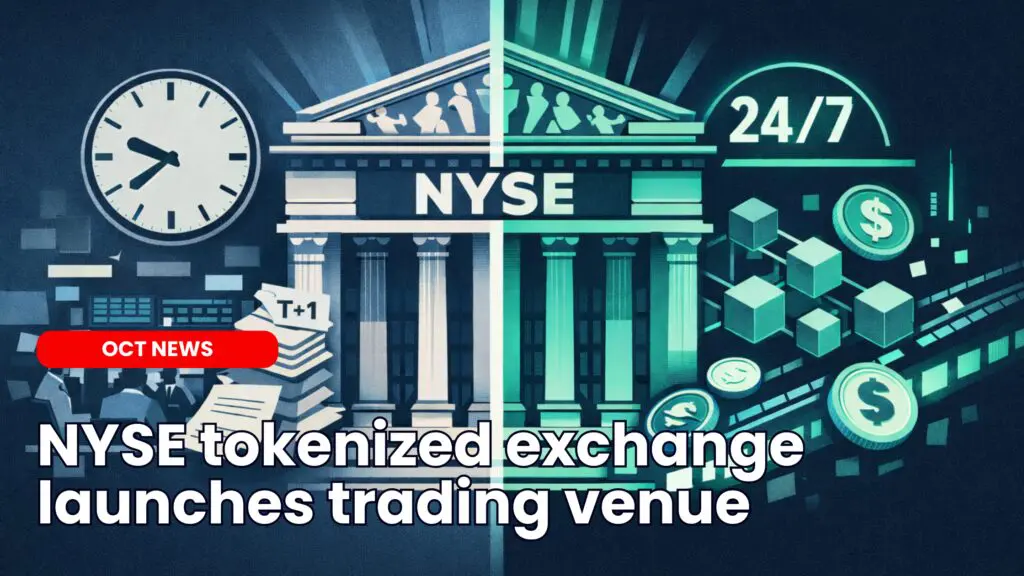
January 10, 2026. The NYSE tokenized exchange marks the New York Stock Exchange’s move to build a new trading venue for tokenized digital securities, signaling a significant step into on chain capital markets. Unlike prior blockchain initiatives, the platform will be entirely separate from NYSE’s existing exchange, offering continuous trading, instant settlement, and stablecoin based funding rails.
High Signal Summary For A Quick Glance
- NYSE has announced a brand-new tokenization platform built as a separate, fully digital trading venue.
- The new exchange will operate 24/7 with instant settlement and stablecoin-based funding.
- Tokens will be natively issued as digital securities rather than retrofitted from existing equities.
- NYSE will operate two parallel systems: a traditional exchange and a fully on-chain digital venue.
- Institutional investors preparing for on-chain equity markets.
- Issuers exploring native digital securities issuance.
- Infrastructure providers competing in tokenized capital markets.
- Market participants seeking 24/7 trading and instant settlement.
Tokenization Trends and Industry Signals Led to NYSE’s Announcement
Momentum in real world asset tokenization built through 2025 as regulators and institutions aligned around the NYSE tokenized exchange, signaling rising confidence in on-chain issuance and settlement. Engagements across regulators, asset managers, and exchanges increasingly reflected support for the NYSE tokenized exchange model, reinforced by stablecoin adoption and successful tokenized fund launches.
While NYSE’s entry into tokenization was expected given these trends, the decision to build a fully separate digital venue stood out. By opting for a parallel exchange rather than adapting legacy systems, the New York Stock Exchange moved beyond incremental upgrades, aligning more closely with crypto native market structures and intensifying competition in on chain equities.

Prior Tokenization Efforts Provide Context for NYSE’s Strategy
Tokenized securities gained traction through 2024 and 2025 as exchanges and crypto platforms introduced blockchain based trading and settlement. Initiatives from Nasdaq, Coinbase, and other global venues enabled fractional ownership, faster settlement, and extended trading hours, but were largely built within existing market structures.
The New York Stock Exchange’s approach differs by creating a fully separate digital venue rather than adapting legacy systems. While similar elements exist elsewhere, the parallel model marks a more direct step toward native on chain equity markets at institutional scale.
Earlier Tokenized Equity Launches Built Market Momentum
Tokenized equity initiatives in 2025 were generally met with positive market and community response. The rollout of tokenized Exodus shares and Nasdaq’s push for tokenized securities lifted sentiment around RWAs, while related crypto and equity markets saw increased activity as institutional adoption narratives strengthened.
Crypto exchanges and on chain platforms later expanded access through tokenized stock offerings and native issuance models. These efforts validated demand for 24/7 trading and faster settlement, but most operated within hybrid structures, highlighting how NYSE’s parallel digital venue marks a more pronounced structural shift.
Comparison with tokenization initiatives from competing TradFi and crypto-native platforms
What to Watch as NYSE Advances Its Tokenized Platform
The project remains early stage, making regulatory approval the primary milestone to monitor. Updates from the U.S. Securities and Exchange Commission, disclosures from the New York Stock Exchange or ICE, and announcements around banking or stablecoin partners will signal whether the platform is moving toward launch.
Execution risks also remain. Technical delays, limited issuer participation, or shifting market conditions could slow progress, while clearer regulation or successful tokenization pilots could accelerate adoption. The next phase will determine whether the initiative becomes a core market venue or a longer-term strategic build.