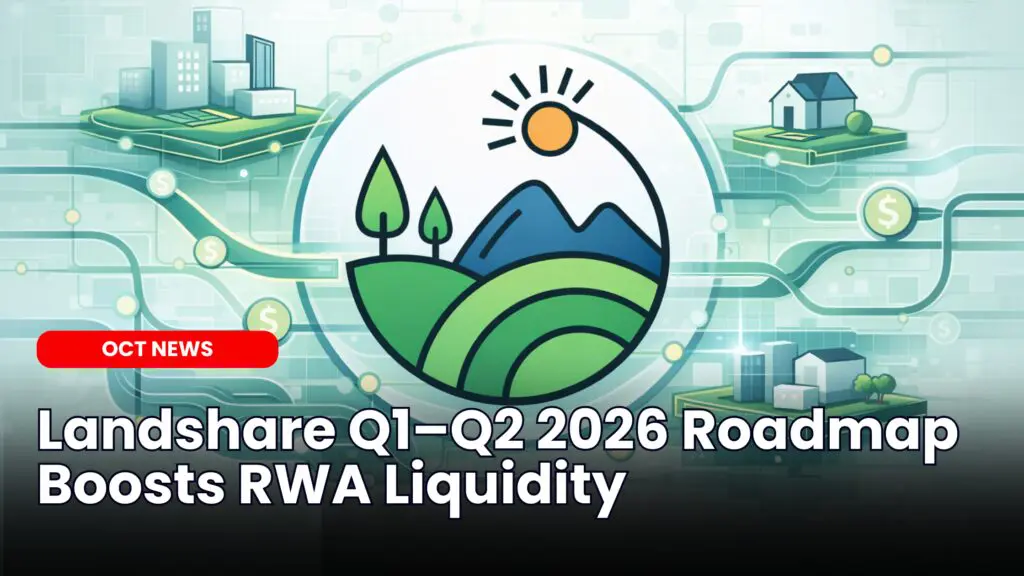
December 26, 2025. The Landshare Q1–Q2 2026 Roadmap outlines major upgrades aimed at improving liquidity, yield generation, and DeFi integration for its Real Estate Asset Token ($LSRWA). The update introduces permissionless secondary trading on decentralized exchanges, removing mandatory KYC for on-chain liquidity.
Key Takeaways
- Landshare unveils a Q1–Q2 2026 roadmap focused on improving real estate liquidity.
- Permissionless DEX trading for $LSRWA is planned without mandatory KYC requirements.
- New yield systems introduce stablecoin income and monthly USD claim mechanisms.
- The RWA Launchpad targets index-style tokenized property funds deployed on chain.
From Crowdfunded Properties to Scalable RWA Infrastructure
Landshare launched in 2021 as a community driven platform for tokenized U.S. real estate, enabling fractional ownership through blockchain based governance. Early development focused on individual rental properties and yield distribution backed by real cash flows.
By expanding into Layer 2 infrastructure and refining compliance frameworks, Landshare evolved beyond single asset offerings. The 2026 roadmap reflects a shift toward scalable RWA infrastructure designed for DeFi composability and secondary market depth.

Price Impact of Landshare’s Q1 Q2 2026 Roadmap on $LAND
Landshare’s announcement of its upcoming Q1 Q2 2026 roadmap featuring permissionless DEX trading, stablecoin yields, monthly USD claims, peg tools, and an RWA Launchpad has generated positive community sentiment but translated to modest short term price gains for $LAND. Current pricing shows $LAND trading around $0.285 to $0.32 USD (CoinMarketCap ~$0.319, CoinGecko ~$0.286), with 24 hour changes ranging from -0.95% to +1.3%. The teaser prompted a brief volume spike and 5 to 8% intraday uplift in some sessions, but overall movement remains subdued amid holiday lows and broader market consolidation.
<<-chart-landshare->>
Landshare ($LAND) Key Updates in 2025
In 2025, Landshare focused on steady ecosystem expansion, improving onboarding, liquidity, and multi chain reach for $LSRWA and $LAND. Key progress included LSRWA Express for stablecoin yields, platform upgrades, and expansion to Plume Network, aligning with the rapid growth of the RWA sector.
Momentum continued through partnerships, compliance initiatives, and a late year teaser for the Q1 Q2 2026 roadmap. With permissionless trading, new yield tools, and an RWA Launchpad ahead, Landshare reinforced its long term strategy of utility driven growth, while $LAND traded steadily between $0.28 and $0.32.
Landshare
Ondo Finance
Centrifuge
RealT
Educational Content: Tokenized Real World Assets and DeFi Evolution
Landshare’s 2026 roadmap highlights how tokenized real world assets can integrate with DeFi through permissionless trading, stablecoin yields, and on chain funds. It demonstrates how blockchain enables fractional ownership of physical property, unlocking global liquidity and yield from rental income. The model also illustrates trade offs between compliance and decentralization, such as optional KYC and regulatory risk. Together, these concepts show how RWAs are evolving from niche experiments into scalable on chain financial products.